What's Actually Working in Enterprise AI Right Now
AI House Event Recap | June 22, 2026

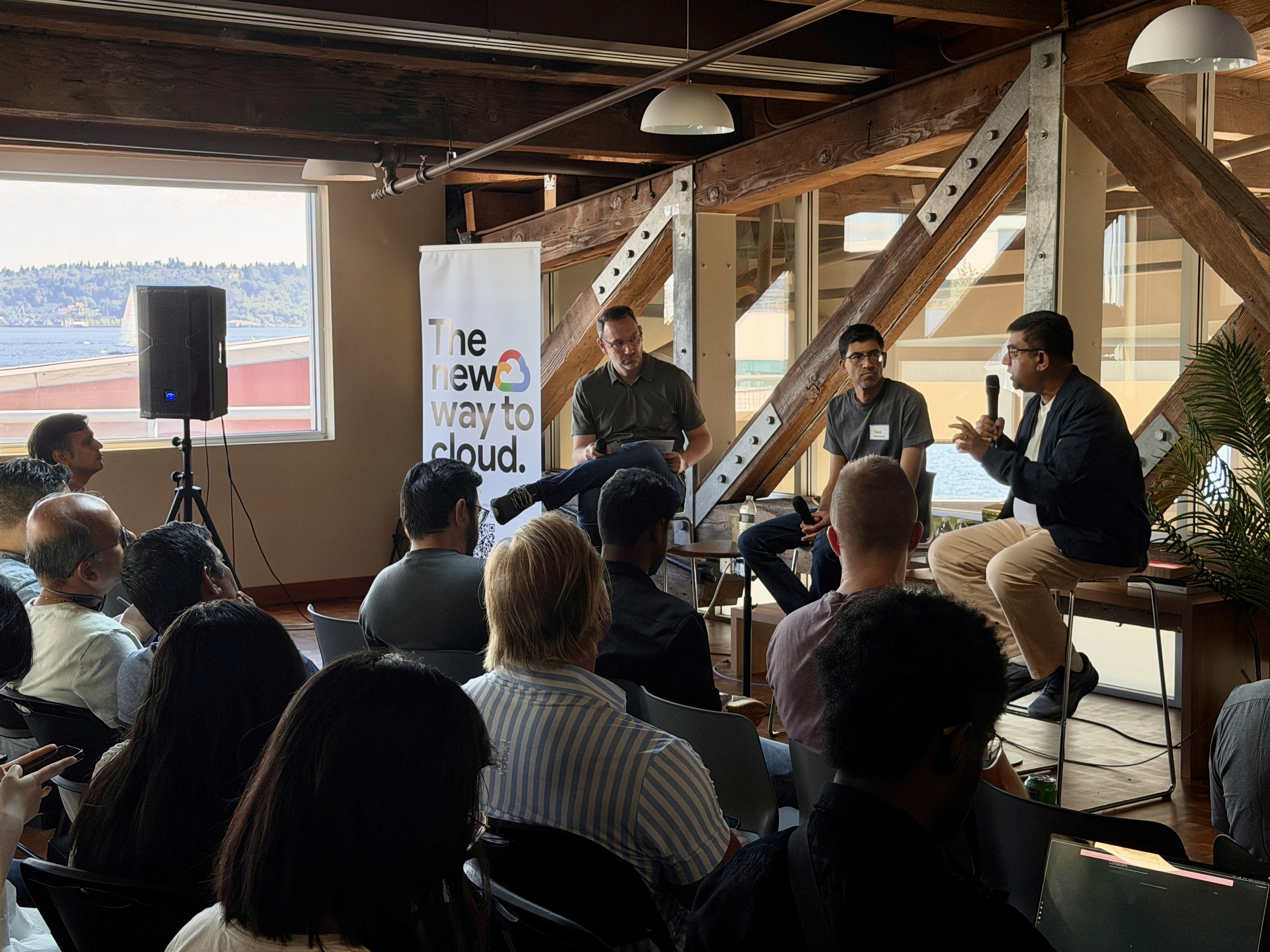
At AI House this week, Vivek Sharma (co-founder of ArchAstro, which recently emerged from stealth), Rajeev Rajan (who leads Revenue and Financial Automation at Stripe and was previously CTO at Atlassian), and Chris Bee (co-founder and CEO of Devplan, an AI House Incubator company that just launched) sat down for a candid conversation on how AI is changing enterprise software — and the opportunities for founders.
Here's what stood out.
Amplified intelligence vs. artificial intelligence
Vivek pushed back hard on the "AI is coming for your job" framing. The biggest progress ArchAstro has made with enterprise buyers, he said, came from being direct that the goal isn't to replace workers — it's to supercharge the people who are already doing the hardest work but lack the tooling or bandwidth to do it at scale. With most enterprises under operating expense pressure and unable to hire, the real question isn't "how do we cut headcount?" It's "how do we get more out of the people we already have?"
That reframe matters for founders. Selling replacement is a fear conversation. Selling amplification is a value conversation.
Where AI is working
Despite the hype, the panel agreed that fully autonomous AI isn't delivering broadly in the enterprise yet. The real productivity gains are happening where AI coding tools meet very narrow, well-defined workflows that still keep humans in the loop — things like automated bug fixes or financial contract review. Rajeev also pointed to agentic commerce as a fast-growing area: at Stripe, an increasing share of purchasing and invoicing interactions are coming through agents rather than humans.
The pattern is clear: specificity wins. Broad autonomy doesn't work yet. Tight, domain-specific workflows do.
But Vivek also warned about over-delegation to AI. For example: a team gets impressed by a model's output, hands it more responsibility, and the work falls apart within days or weeks. The teams getting real results, he said, are the ones that track back from every failure and encode corrections into deterministic checks rather than trusting the model to get it right next time.
The org chart is flattening into a graph
Rajeev described a shift from traditional pyramid organizations to what he called a "graph of dense nodes" — smaller, talent-heavy teams operating more dynamically. Since the cost of writing code is dropping toward zero, the bottlenecks are shifting to what he called "left of code" (defining intent and specs) and "right of code" (CI/CD, testing, production deployment). The people who carry both deep domain context and the ability to build end-to-end are becoming the most valuable in the organization.
Chris added that the age of the generalist is arriving — engineers who can think like product builders, not just write code. Vivek went further: at ArchAstro, the contract between team members is shifting from strategy documents to test cases. The person who can define the right test case is the person steering the ship, regardless of title.
Startups can still win
Can startups survive as the labs push further into the stack?
Vivek was blunt: if you believe the labs will eat all software, you're betting on god-level superintelligence — and if that happens, everyone's toast anyway. For everyone else, there's plenty of room. Smart enterprises will stay focused on their core business, not build internal replicas of your product. As Vivek put it: nobody is waking up and saying "I'm going to reinvent Cloudflare." Their focus is your strength.
Rajeev agreed, but from a longer arc. His read is that we tend to overestimate change in the short term and underestimate it in the long term. In the near term, there's real opportunity for startups to navigate the transition and solve problems the labs aren't going after.
But the panel was clear that shallow wrappers on foundation models won't cut it. Chris warned that if your product isn't hard to replicate, it's too easy for a customer to assign an engineer and rebuild it in two weeks. Vivek's answer: make your platform infinitely extensible — let customers run their own code and agent scripts inside your runtime, so your product becomes indistinguishable from their own tooling. That's a moat built on depth, not hype.
The bottom line
The through-line of the entire conversation: ignore the noise, build for the messy reality enterprises actually face, invest in domain depth, and sell amplification over replacement. As Vivek put it when comparing Seattle's approach to San Francisco's startup-selling-to-startup echo chamber: "Real ARR versus made-up ARR."
Thanks to Vivek, Rajeev, and Chris for a great conversation — and to everyone who came out. Keep an eye on our Luma calendar for upcoming events at AI House.


