
Talk Nerdy to Me: Cutting-edge AI research from the University of Washington
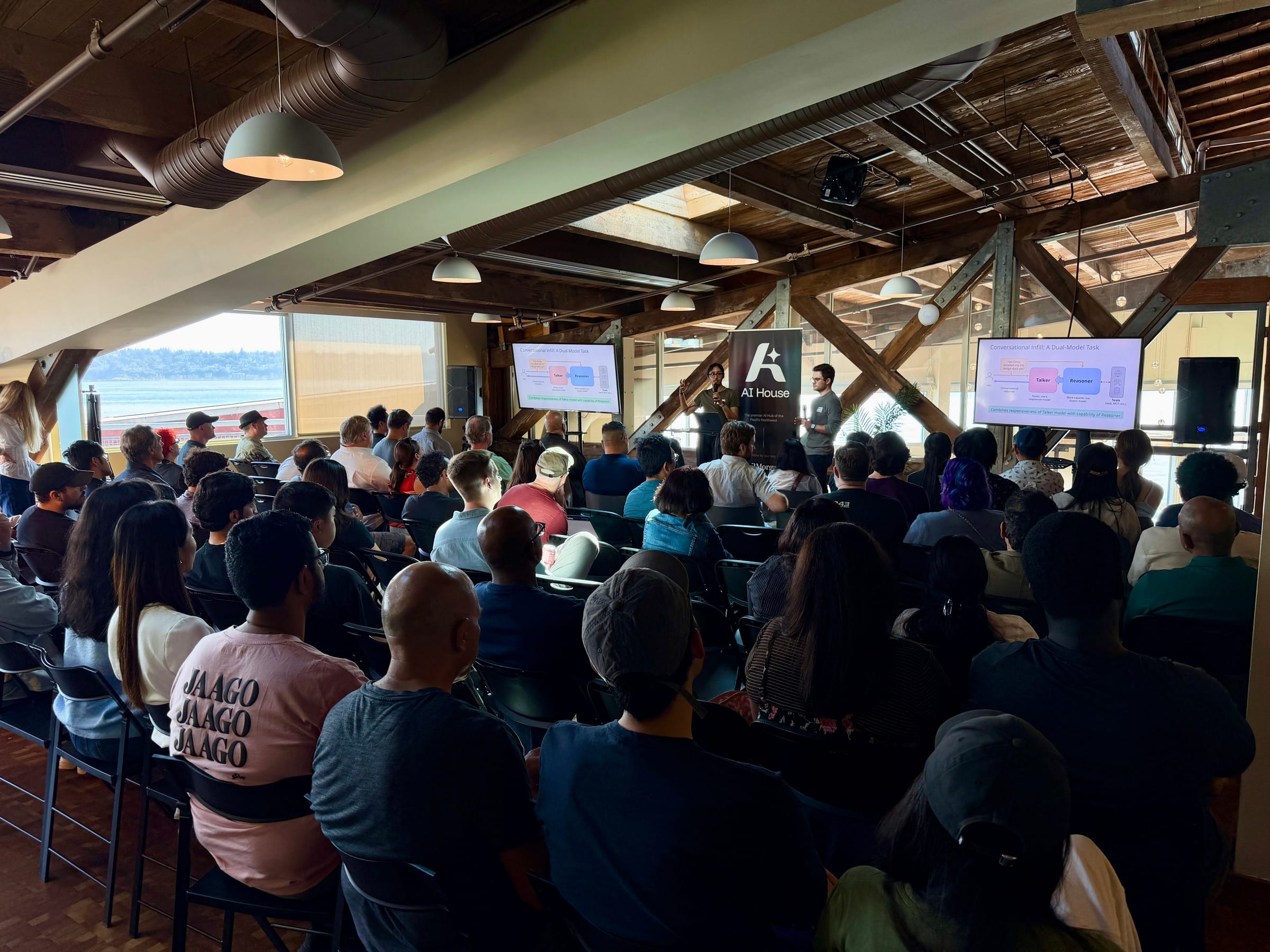
Woof! It was a packed room at AI House for our latest Talk Nerdy to Me event, which featured researchers and students from the University of Washington's Paul G. Allen School of Computer Science & Engineering sharing their AI work. We love giving these innovators a platform to talk about AI research with the Seattle-area founders and builders putting it into practice.
Learn more about the researchers and their demos:
Vidya S. & Zachary Englhardt — ConvFill
ConvFill pairs a fast, lightweight on-device model with a more powerful cloud model to close the gap between real-time voice response and deep reasoning. The lightweight model handles conversation instantly while the larger model retrieves information and reasons in the background, then feeds the answer back. It runs on consumer hardware with no GPU required.
Guorui Xiao — KathDB
KathDB answers natural-language questions over multimodal data (e.g., images, text, and tables) by synthesizing plans in which each step is generated code, so the system can fuse model inference with relational work and search for the cheapest execution path. It matches Claude Code's answer quality at 98% lower execution cost on average (up to 99.7%), and beats expert-written plans by 98.7%.
Tapan Chugh — A Social Harness for Agentic Societies
As AI agents increasingly negotiate and transact on behalf of their users, they must interact with other agents whose goals may not align with their own. Chugh's research shows current agents are prone to poor coordination and exploitation by dishonest counterparts. His team is developing a "social harness" layer that applies trust and coordination norms from human institutions to manage these interactions safely.
Anat Caspi, PhD — Transportation Data Observatory
Throughout the state of Washington alone, more than 700 sidewalk, crossing, and micromobility infrastructure projects have been implemented since 2023, but the data record from these projects is typically inconsistent and never reused. This impacts how effectively and efficiently we measure our cities and towns, how we evaluate project impacts and prioritize the next projects. The Taksar Center for Accessible Technology team built the Transportation Data Exchange Infrastructure (with USDOT support)- an AI-enabled platform that maintains this data as a routable, decision-ready network. It is now used by more than 940 people across 49 project groups and has already supported a funded infrastructure fix in Pierce County.
