There Had to Be Another Way

Last week I sat down to watch a basketball game with my son. He's a huge NBA fan, and I block 4:00 to 6:30 PM on my calendar for my family, so this was supposed to be protected time.
I barely heard a word he said.
I had seven problems in my head that felt like they needed solving right then. Two or three coding sessions were stalled, waiting on me to make a call before anything else got built. And like a lot of people I know, I'm a little obsessed with getting full value out of my Claude Max and ChatGPT Pro plans. If an agent was stuck, I was wasting a five-hour session or a week of credits. So I sat next to my son and answered agents instead.
That's the part of the AI story nobody posts about. We read about people who are 10x more productive, and we feel behind. So we spin up more agents. They take work off our plates, then hand us back decisions: which option, what to build next, is this right. Every one needs context to make, and none of them ever feels finished.
I didn't fix anything that night. I took a step back. I kept thinking of Frank Costanza explaining how Festivus was born: there had to be another way. The long-term answer can't be 996 or bust, 9 AM to 9 PM, six days a week, for anyone who wants to build a lasting company.
So I started to think about what an AI-native company should actually look like. Everyone gets real leverage, not just the founder. Everyone has tools to run the company's best practices, and can shape those tools around how they like to work. They do more, and it doesn't take more of their time.
Getting there starts with one shift: in an AI-native company, the scarce resource isn't labor. It's decisions. Every system you build has to spend them carefully.
I don't have it all figured out. But between my own experiments building an AI-native venture firm and a lot of conversations with founders, I've learned enough to share what's working. Six months ago I wouldn't have had time to write this. This series is the playbook, one system at a time.
What AI-native actually means
A playbook is just a set of decisions you've already made, so they can be applied without fresh judgment every time. When Kaya, my AI assistant, offered founders I was courting meetings three weeks out, I didn't fix that one meeting. I wrote down tiers, and how fast each one gets booked. Now Kaya makes that call, not me. Every rule you write down is one less call that you, anyone on your team, or any agent has to make from scratch.
Most companies today are AI-using. People keep ChatGPT or Claude open in a tab, and some of them are better at using these tools than they were a year ago. That's good, but it isn't the same thing.
In an AI-native company, every person and every agent executes the company's best practices, consistently. Two things make that possible. First, the playbook is written down so an agent can run it, not just a trained employee. Second, the playbook gets better from its own execution: when something goes wrong, the fix goes back into the playbook, and every person and agent picks it up.
Here's the part people miss: AI can surface your playbook, but it can't choose it. An agent can read a year of your meeting notes and show you the patterns you already follow. It can't tell you which of them is right for your business. The SLAs you hold yourself to, how you treat a customer, the bar for a hire: that's judgment, and it's yours.
That's also why I don't buy the argument that you should wait for big tech to solve this. They'll make the tools better and cheaper every quarter. They can't hand you a playbook for your company. Your confidence in how your company should run is the edge. The tools just amplify it.
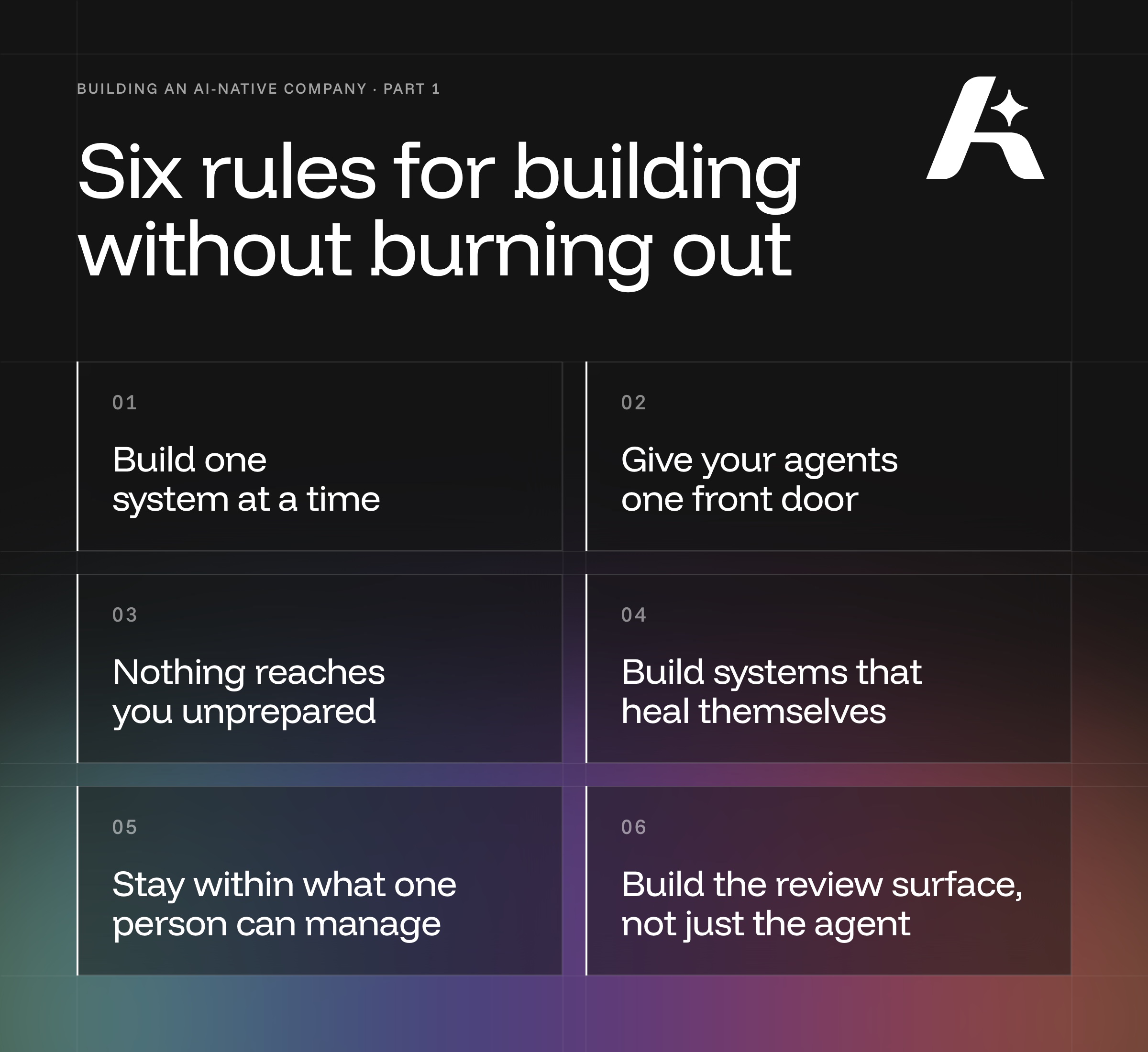
Six rules for building without burning out
The hidden cost of AI isn't the subscription. It's that every agent you add removes work and creates decisions. Each of these rules is about spending your decisions carefully.
1. Build one system at a time. Get one system working before you start the next. A half-built system is worse than none, because it creates decisions without saving any work. If your company has no playbook yet, that's fine: do the work by hand, write down how you did it, and automate it once the pattern holds.
2. Give your agents one front door. When every agent can interrupt you, you get interrupted all day. In my current setup, one chief-of-staff agent receives everything the others need from me and decides what's worth my attention. Everything else waits.
3. Nothing reaches you unprepared. An agent that asks "what should I do?" hasn't finished its job. It should arrive with the context summarized, the options laid out and a recommendation. My morning brief only carries items that are ready for a yes or a no.
4. Build systems that heal themselves. Every system I run logs what it does and sends a heartbeat. When something breaks, the problem shows up in one place where people and agents can both see it. One agent's whole job is watching the others: it notices a problem, works out what probably caused it and proposes the fix. Today I still approve each fix. The goal is that small, reversible problems get fixed without you, with a note that they were, and only real changes come to you.
5. Stay within what one person can manage. Management research doesn't agree on a magic number for direct reports, but it lands in the high single digits. One study of more than 20,000 managers found engagement peaked at eight to nine direct reports. That research is about people, not agents, but the limit comes from the same place: each agent needs you to review and correct its work. I can manage six to eight agents on the work side and two or three on the personal side.
6. Build the review surface, not just the agent. Agents do the work, but you still make the call, and how fast you make it depends on what you're looking at. It's never been easier to turn a process that needs human review into a simple page that shows exactly what you need, the way you want it: a Claude Artifact, or a Page in ChatGPT Spaces on its paid business tiers. Some pages you'll keep. I have one pinned for reviewing applicants to AI House, and I use it every week. Others you'll use once: when I'm training a system, I'll have Claude build a page that lets me label fifty examples quickly, then I never open it again. Both are worth building. Anyone on your team can make one this week, no engineering required, and it's often the best first step before they ever touch an agent.
Why AI House cares
There used to be a category of VC called an "Internet investor." Nobody has that title anymore, because every company runs on the internet. AI is headed the same way. At AI House, we care about the technology our companies build. But we care just as much (if not more) about how the companies themselves are built: whether AI is woven into how the company actually operates. We think that's where the lasting businesses will come from. Not from using AI, but from running on it. That's why we're writing this series.
What this series will cover
Each installment applies these rules to one system, in the order you'd build them:
- Part 2: Your first hire, an AI executive assistant. It's the first thing I tell founders to do. Scheduling eats more of your head than you think, and getting it out of your inbox gives you real time back. Mine is Kaya, and it books meetings from the rules I wrote down.
- Part 3: Choosing your roster. Which agents you actually need, and which are really just skills one agent should carry.
- Part 4: Everyone is a manager. How to review and coach your agents the way you'd coach a person.
- Part 5: The knowledge base. Your company's shared context and your own personal one, so agents can read how you work.
- Part 6: Agents talking to agents. How work moves between them without coming back through you.
- Part 7: Personal versus shared. Which agents, tools and pages belong to one person, and which work for the whole team. This is where I'm still learning, so I'll write it as I go.
- Part 8: What humans should do. The work that stays ours.
By the end, you should have a handful of agents running on your own playbook, and a rhythm for decisions that fits inside your working day.
So what does my evening look like now? Better, not perfect. I gave my agents a written rule: on weekdays from 4:00 to 6:30 PM, hold anything that can wait. They keep it. The one who still breaks it is me. I still message them during that block sometimes. That's the next decision I need to make and stick to.
I haven't seen this play out across a team yet. That's my next test, and I'll write about it as it happens.
Your assignment
Before the next installment, keep a log of every scheduling decision you make for one week: who you said yes to, what you pushed, what you protected, and why. Then write your rules down on one page.
That page is the first page of your playbook, and it's exactly what you'll hand your AI executive assistant in Part 2.